Iatmul Mosaics

Iatmul Mosaics

  • About

    by Therese Woodcock and John Hood-Williams

    We have both studied this collection of adult Mosaic responses and note that the most striking characteristic of the whole collection is the high degree of similarity between the Mosaic responses of all the subjects. Certain elements seem to stand out. We list these below, together with brief comments on our understanding of them meaning of some of them.
    1. There is a total absence of abstract patterns, which in all other collections we know form the largest single category.
    2. Perhaps most striking of all is the fact that common to every Mosaic in this collection is a unique style of handling the Mosaic pieces. This can best be described as “the weaving mode”. The clearest example of this in the collection is 6F. This process is described by Dr Metraux as the interlocking of the principles of symmetry and complementarity.
    We see the “weaving mode” as being perseverative and non-adaptive and while accounting in part for the strength of the continuity of this culture, it may be an obstacle to finding new patterns of thinking which are necessary for a successful move into the modern world.
    Besides this mode of handling the Mosaics, there are actual Mosaics designated as “weaving patterns”. The designs are often called “belem” or basket-weaving. Examples are 1M I & II, 8M I & II, 18M I. All the designs made by the women with the sole exception of 4F can be placed in this category
    3. Nowhere in the collection are any human figures represented.
    4. Movement as we understand it from Western collections of Mosaics does not appear at all in this collection. We will define movement here as being clear directional lines, i.e., outward-pointing movements, inward-pointing movements, conflicting directions of movement, or circular movement. These designs are all static.

  • Specification

  • Delivery & Returns


download

You May Also Like

Play and Symbolism in Lowenfeld and Winnicott

In her biography of Margaret Lowenfeld which appears as the introduction to the book of Lowenfeld’s selected papers entitled Child Psychotherapy, War and the Normal Child (1988),...
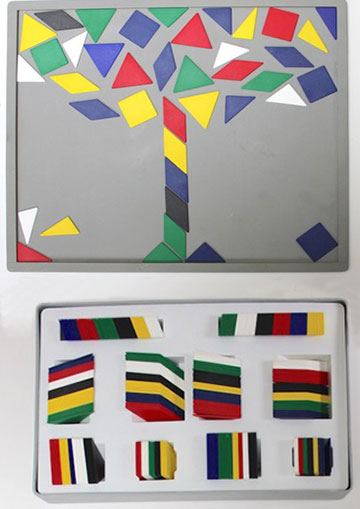
Lowenfeld Mosaics – complete set of tiles and tray

By Margaret Lowenfeld This order comes with a free copy of Expressing the Shape and Colour of Personality by Therese Woodcock and The Lowenfeld Mosaic Test book. Price: £123.00 pl...
Price: £123 £123
The Significance of Play

The Significance of PLAY in the Normal Development of Children By Margaret Lowenfeld 1938 When the adult uses the word ”play” in his description of children or his thoughts abo...

Child Psychiatry and Medicine

The subject I have been asked to put before you today is a discussion of the relation between Child Psychiatry and Children’s Medicine. I submit that this is a particularly f...