Cleanliness and Tidiness
Cleanliness and Tidiness

  • About

    By Dr. Margaret Lowenfeld

    Report of the first of four lectures in a course of eight on “Common Difficulties in Normal Children” arranged by The Institute of Child Psychology and delivered at Friends’ House, Euston Road, N.W.1, on Wednesday, November 7th 1934.)

    Lord Northbourne (President of the Institute of Child Psychology) presided and, in introducing the lecturer, said: It is a great pleasure to me to be here to-night and to see such a splendid audience at the first of this particular series of lectures. It is also a pleasure to be able to do what I can, even in such a small way as this, to help the work of the Institute of Child Psychology. It is for that reason I am here, not that I am particular an advocate of those virtues, cleanliness and tidiness, which are the subject of the lecture. At the moment I am not a good example of those virtues because I have just come from a train journey. I, however, distinctly remember an earlier period when I was not only not an example but a conscious opponent of those virtues. I suppose we have all passed that stage, more or less.

    To-night Dr. Lowenfeld will give us the first of a series of eight lectures on “Common Difficulties in Normal Children”. You are going to hear, I think, something with regard to the application of real scientific method to problems which have hardly previously been dealt with from that point of view. They have been left to chance and to individual judgement. Recently, however, statistical and analytical methods have been applied to the study of common psychological problems. Some people are rather afraid of that fact. They do not like the idea that the human mind can be treated scientifically. It is thought to be shocking that some dehumanizing influence should be exerted on the human mind by statistical work; that science is soulless and that, perhaps, the tendency of such work may be definitely anti-religious. I think religion has hitherto been left free very largely to deal with psychological problems. On the other hand, there are a good many reasons for which I disagree with that view. Very few of us realize how far we are automatic, how small is the degree of freedom we have. That is particularly true with children. There is no reason why we should not, with advantage, find out a great deal more about that part of our consciousness which is largely reflex and not conditioned by active or conscious thought on our part. I also think that the highest flights of the human mind must necessarily always remain outside the range of exact science. If any other condition arose, if we could docket and ticket everything, we should arrive at a point from which we could not proceed any further. But it is also true that the more we can remove from the field of speculation, the more we can make strictly scientific, the more room there is for free development of thought in new directions. A very vague figure illustrating that point was recently put before me by a Viennese psychologist, who said: If you take the whole sum of scientific knowledge which is filed and ticketed and represent it by a circle, the circumference of that circle represents the contact of the human mind with the Unknown. The more purely scientific knowledge, in the strict sense, the bigger your circle becomes, and the greater the contact of the human mind with the Unknown and the greater the field of progress. So it seems to me that we need not be at all afraid of the work of psychology. It is rather aiming at a release from unseen bonds of one kind and another which restrain us and keep us from further movement in an outward direction.

  • Specification

  • Delivery & Returns


download

You May Also Like

Play and Symbolism in Lowenfeld and Winnicott

In her biography of Margaret Lowenfeld which appears as the introduction to the book of Lowenfeld’s selected papers entitled Child Psychotherapy, War and the Normal Child (1988),...
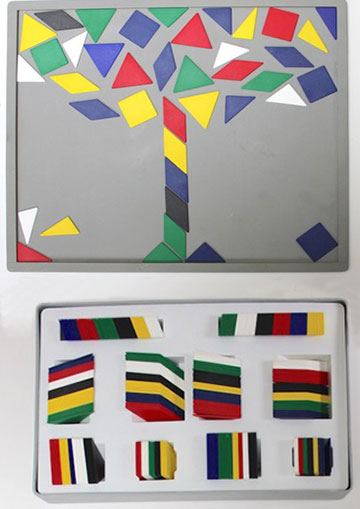
Lowenfeld Mosaics – complete set of tiles and tray

By Margaret Lowenfeld This order comes with a free copy of Expressing the Shape and Colour of Personality by Therese Woodcock and The Lowenfeld Mosaic Test book. Price: £123.00 pl...
Price: £123 £123
The Significance of Play

The Significance of PLAY in the Normal Development of Children By Margaret Lowenfeld 1938 When the adult uses the word ”play” in his description of children or his thoughts abo...
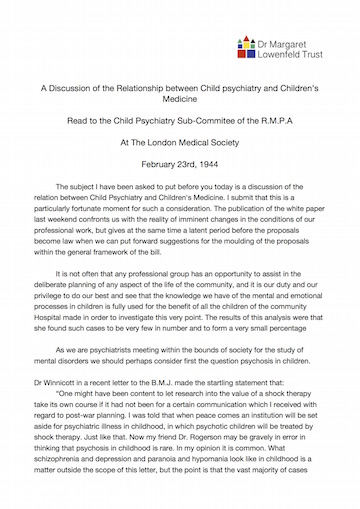
Child Psychiatry and Medicine

The subject I have been asked to put before you today is a discussion of the relation between Child Psychiatry and Children’s Medicine. I submit that this is a particularly f...